Abstract

Generative action policies based on diffusion or flow matching excel in behavior cloning, yet their iterative sampling is prohibitive for high-frequency robot control. While recent one-step formulations alleviate this latency, they inevitably discard the intermediate trajectory evolution that provides crucial action correction. Directly recovering this mechanism by explicitly estimating a training-time drifting field is mathematically ill-posed due to extreme conditional demonstration sparsity. We introduce Implicit Drifting Policy (IDP), a one-step imitation learning framework that brings the training-time correction of Drifting into policy learning without explicit vector field estimation. IDP extracts a conditional expert geometry from the local variation of observation-similar expert actions, and compares it against a global reference geometry to isolate condition-specific constraints. This local geometric structure adaptively weights a scalar potential objective. Combined with an expert-proximal terminal evaluation, IDP directly enforces manifold constraints on the one-step generator during training. Extensive evaluations across 2D, 3D, and real-world manipulation tasks show IDP effectively maintains adherence to valid action manifolds, improving upon explicit drifting methods and achieving competitive performance with strong one-step baselines.

From Explicit to Implicit Drifting

Explicit drifting tries to construct corrected targets by estimating a drifting field around the current policy prediction. In behavior cloning, each condition usually supplies only one expert action, so this field degenerates into an unstable, mini-batch-sensitive signal. IDP instead reads the corrective structure directly from demonstrations: observation-similar expert actions define a conditional local geometry, which becomes the source of a one-step training correction.
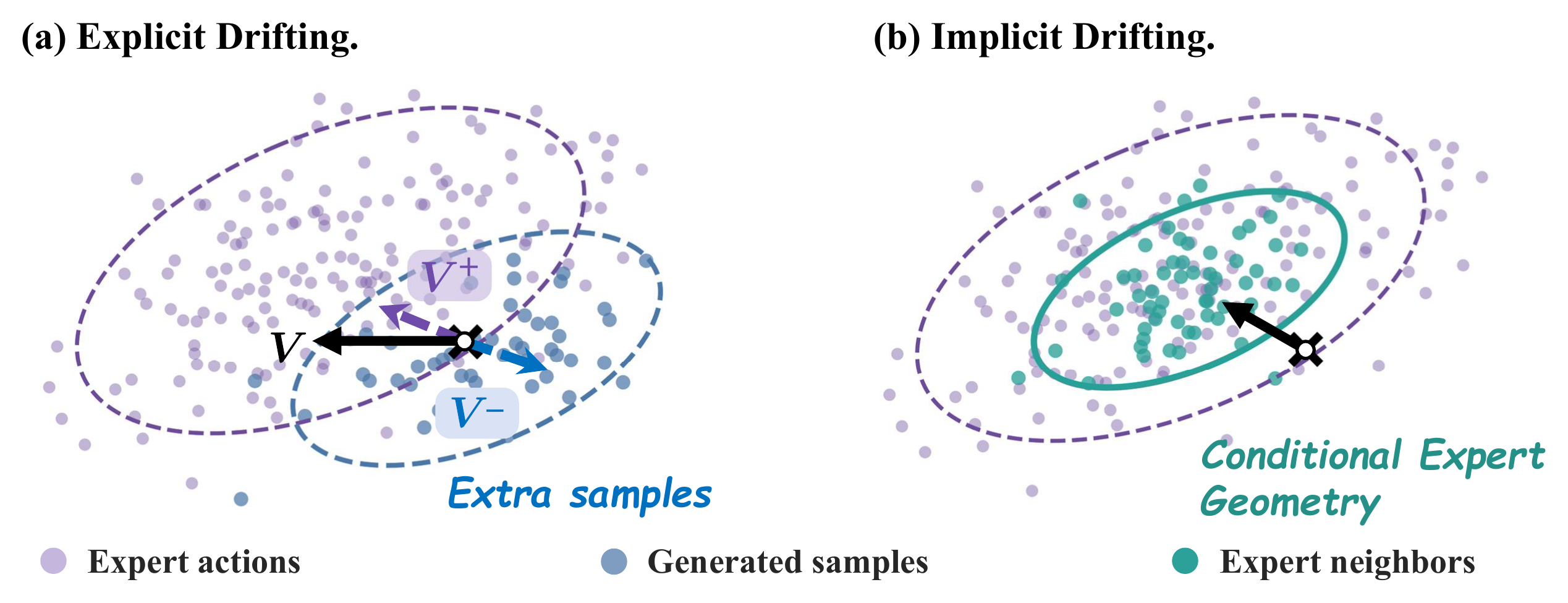
Explicit drifting versus implicit drifting
IDP replaces explicit field estimation with demonstration-supported conditional expert geometry.
Sparse conditions Explicit drifting degenerates

Per-observation demonstrations are too sparse to support a reliable conditional vector field.

No field regression Implicit correction

The correction is induced by a scalar potential, not an explicit drifting vector field.

Local geometry Condition-aware constraints

Observation-similar demonstrations identify the action directions that should be tightly controlled.
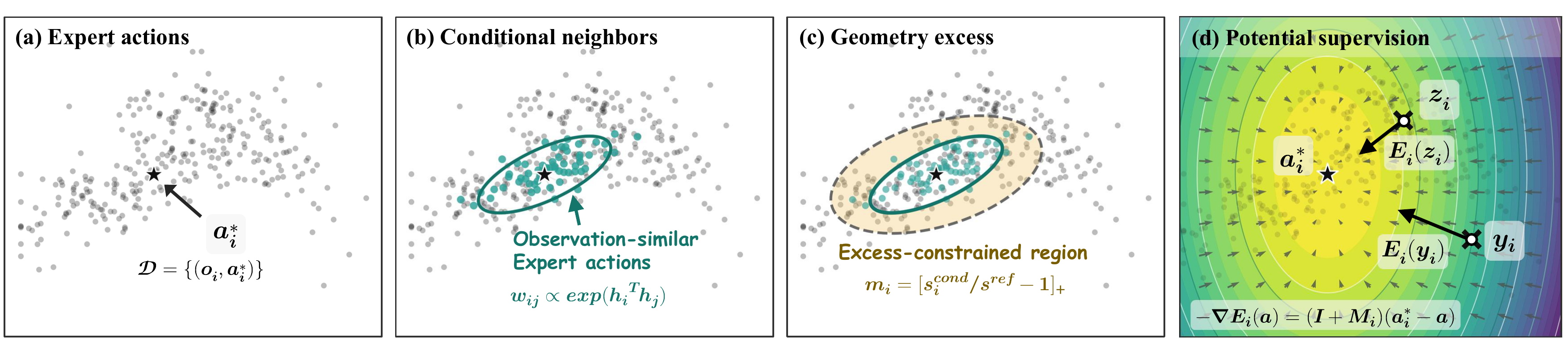
Method Overview

IDP anchors each training sample at its expert action, retrieves observation-similar expert neighbors, compares their conditional geometry with a global reference geometry, and uses the resulting local geometry excess to define an adaptive potential. The shared policy is evaluated both at the one-step deployment point and near expert actions during training, so the deployed predictor internalizes local manifold constraints without adding inference-time steps.

Implicit Drifting Policy method pipeline
Conditional neighbors produce a geometry excess, which shapes the potential used for IDP supervision.
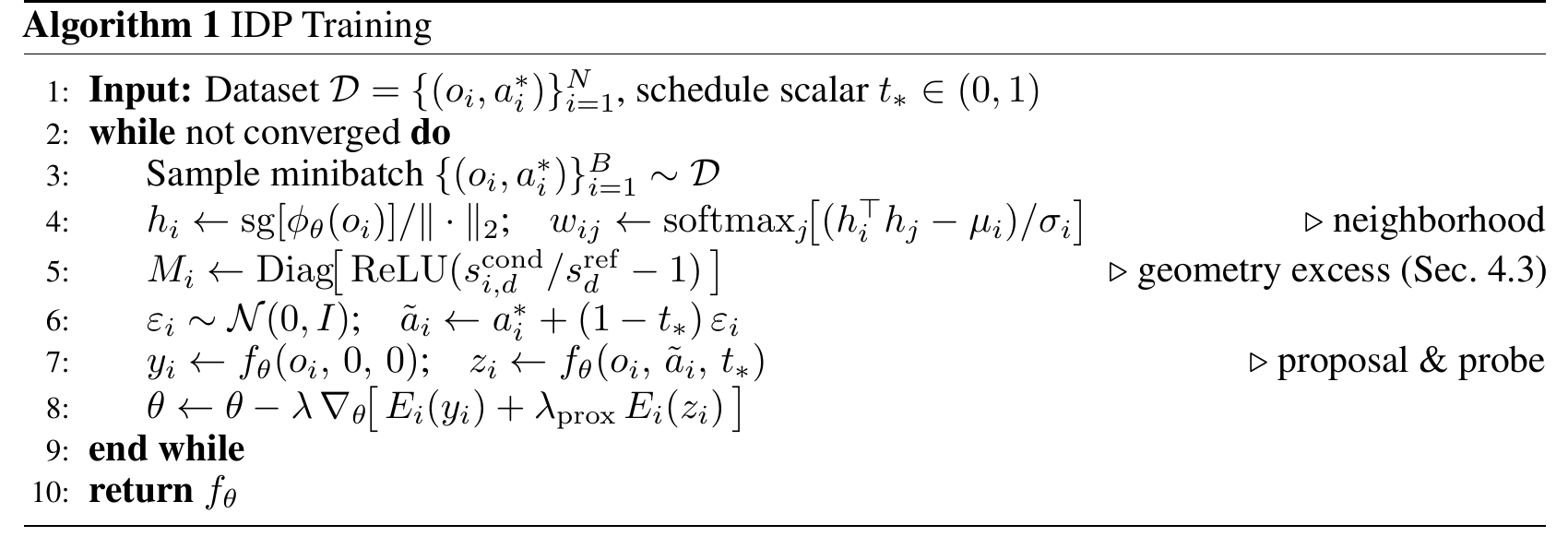
IDP training algorithm pseudocode
Algorithm 1 makes the training loop explicit: compute the conditional neighborhood, form the geometry excess, evaluate the proposal and expert-proximal probe, then optimize the geometry-aware potential.

Simulation Benchmarks

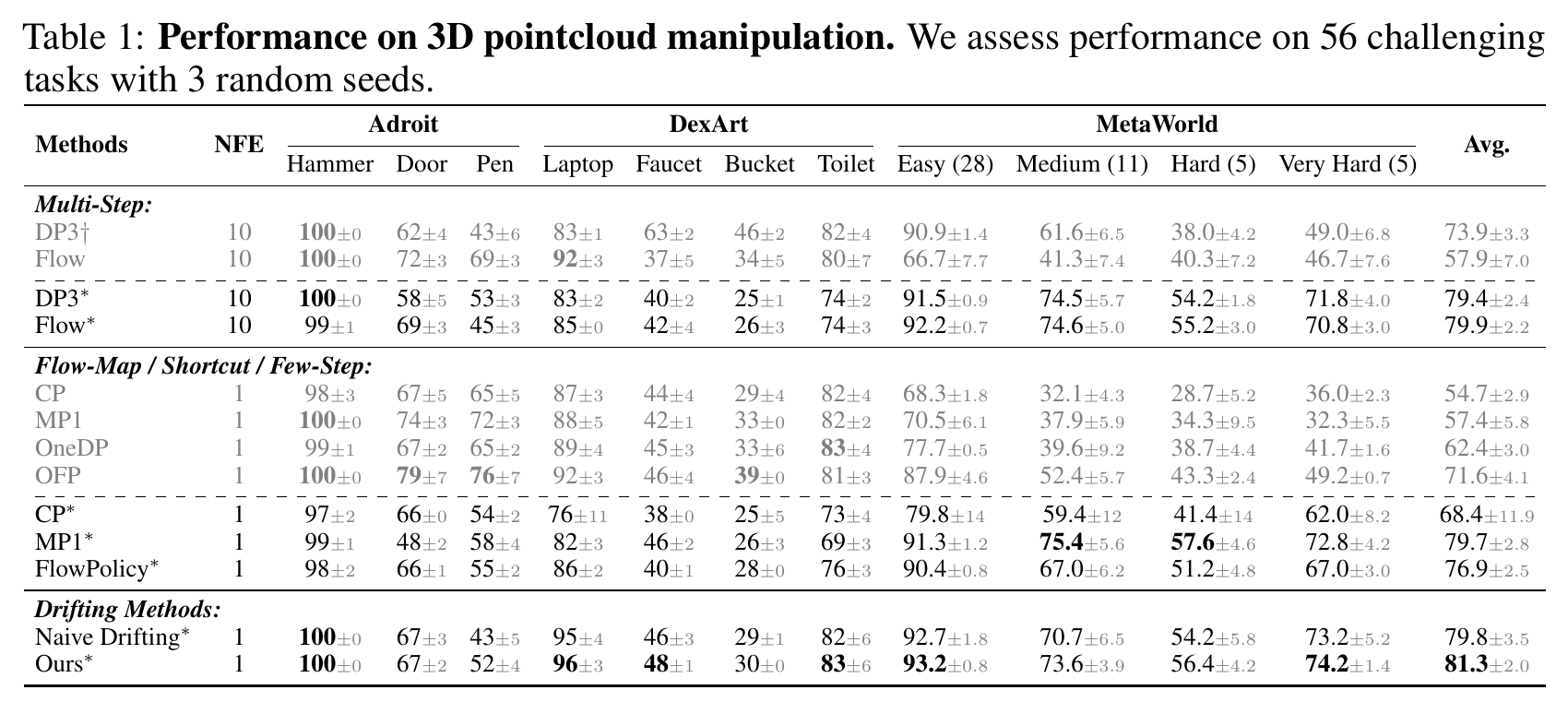
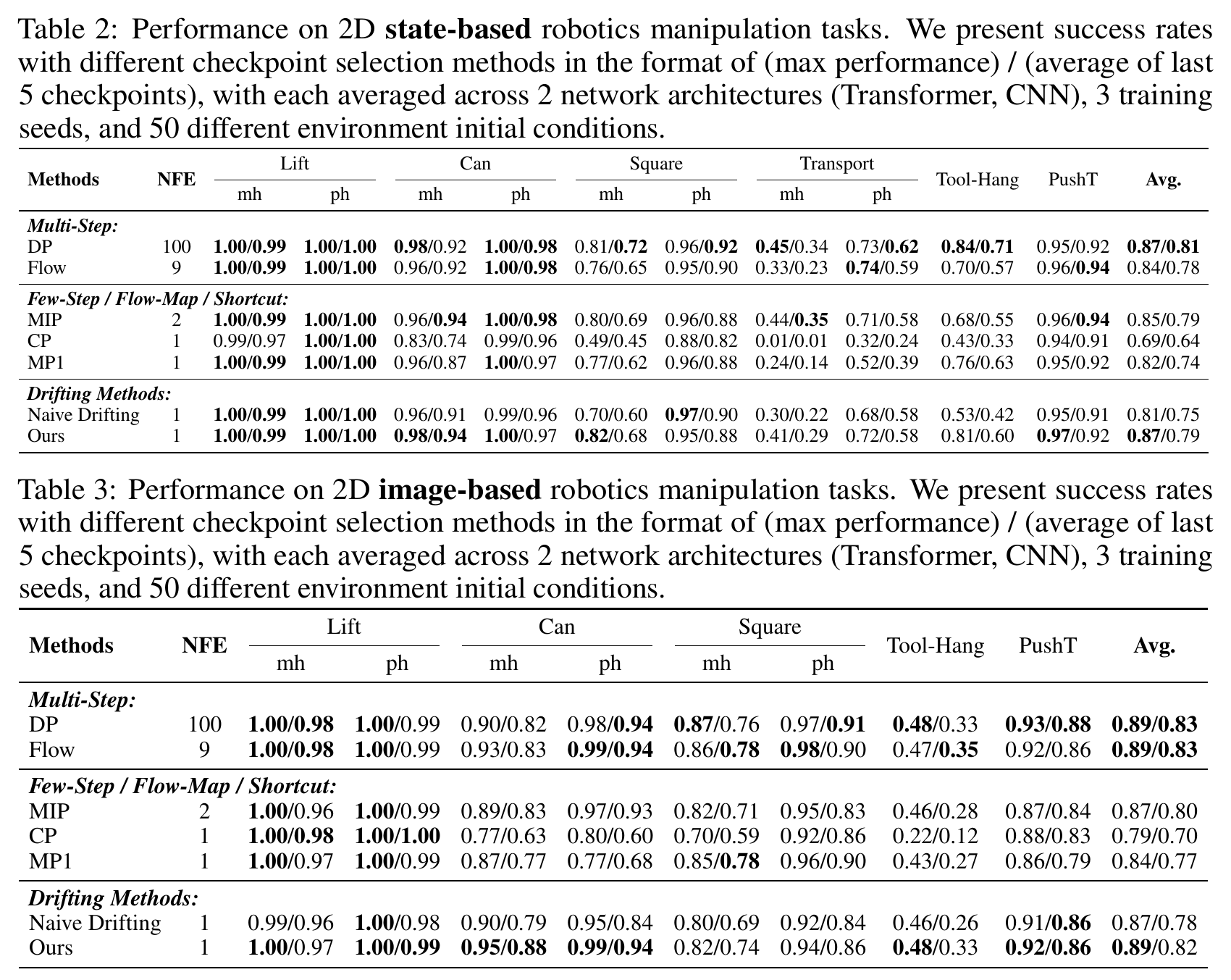
IDP is evaluated across 2D state- and image-based manipulation, 3D pointcloud manipulation, and real-world robot control. The main simulation results compare multi-step generative policies, few-step shortcuts, strong one-step baselines, and explicit drifting variants.

3D pointcloud manipulation result table
Performance on 56 3D pointcloud manipulation tasks across Adroit, DexArt, and MetaWorld.
2D state-based and image-based manipulation result tables
State-based and image-based Robomimic, Tool-Hang, and PushT evaluations.

Real-World and Ablation Results

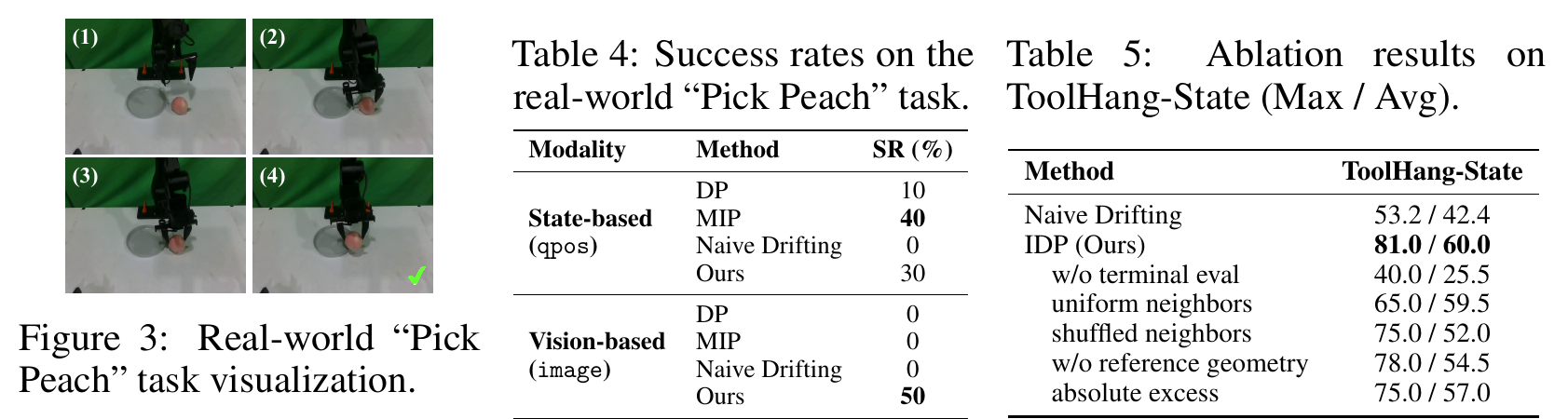
The real-world Pick Peach task tests whether a one-step policy can stay on a valid action manifold under visually grounded control. Ablations further isolate the contribution of expert-proximal evaluation, condition-specific neighbors, and reference-geometry comparison.

Real-world and ablation result tables
Real-world Pick Peach results and ToolHang-State ablations from the paper.
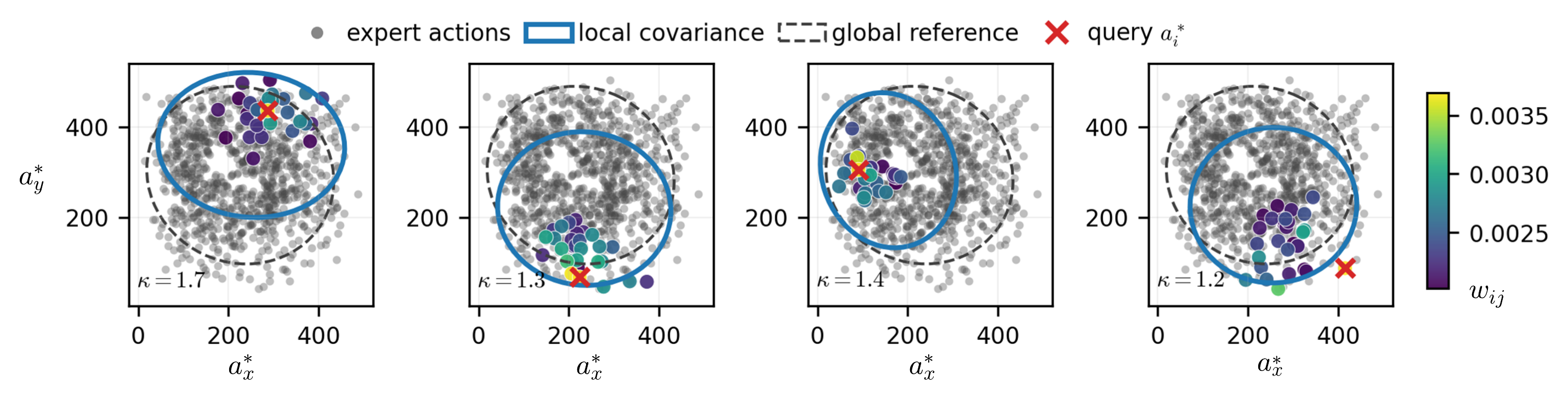
Observation-conditioned expert geometry on PushT-State
Observation-conditioned expert geometry on PushT-State: local covariance differs from the global reference.